The $469 Billion Question Every Business Leader Must Answer
The numbers are no longer speculative. According to Gartner’s 2025 enterprise technology forecast, the global blockchain market is on track to surpass $469 billion by 2027, growing at a compound annual rate that outpaces even cloud computing in its early years. Yet for every JPMorgan deploying blockchain at scale, there are dozens of mid-market executives still asking the same question: Is the business case for blockchain adoption actually real, or is this another Silicon Valley headline?
The answer, backed by an accelerating body of enterprise evidence, is unambiguous: blockchain is no longer an experiment. It is infrastructure.
At its core, blockchain is a decentralized ledger technology — a system that records transactions across a distributed network of computers in a way that makes records tamper-proof, transparent, and auditable without requiring a central authority. Think of it as an indestructible digital notary: one that works around the clock, never loses paperwork, and cannot be bribed, hacked, or coerced into falsifying a record.
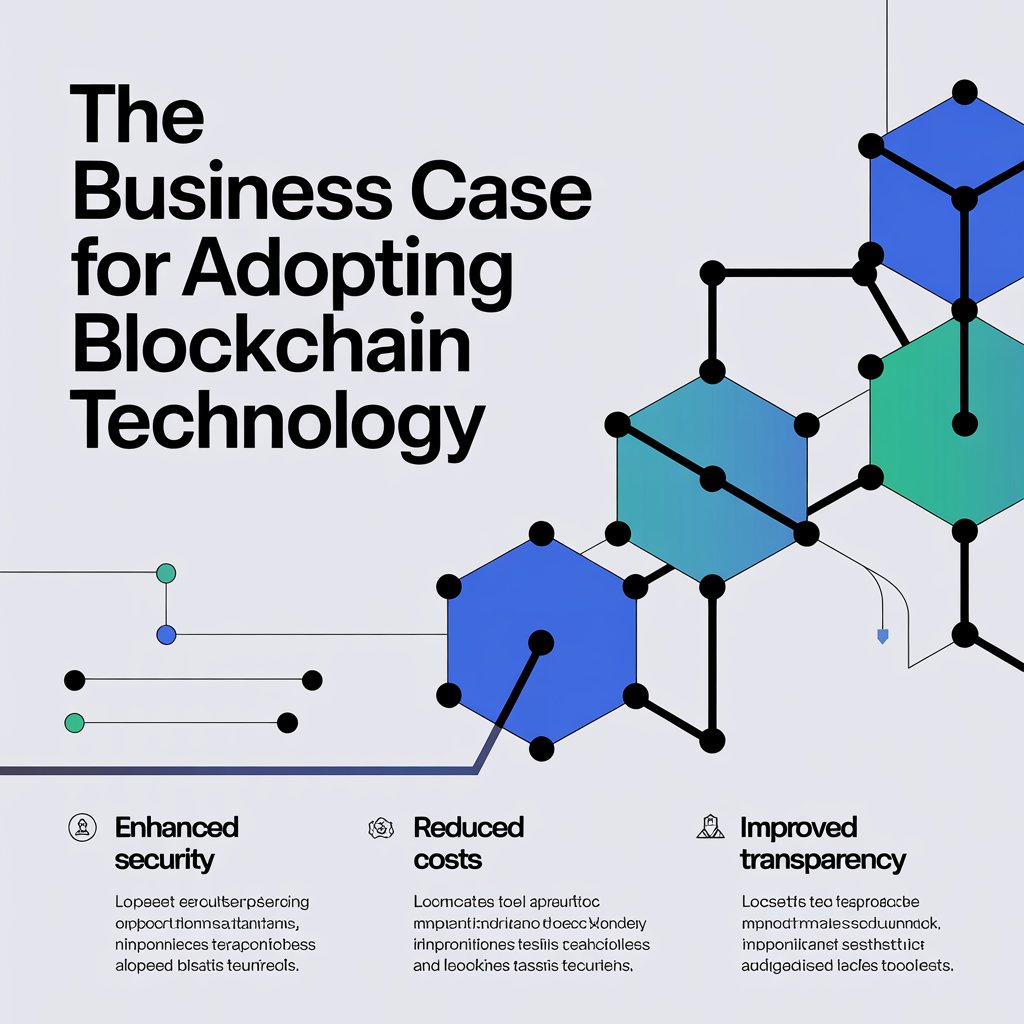
For business leaders in finance, supply chain, healthcare, and e-commerce, the implications are profound. Blockchain adoption is delivering measurable ROI through three primary vectors: cost reduction (up to 30% in supply chain operations alone), data security via immutable records that eliminate single points of failure, and process automation through smart contracts that execute transactions without human intermediaries.
This article builds the comprehensive business case for enterprise blockchain adoption in 2026 — covering the fundamentals, the quantifiable benefits, real-world industry case studies, the honest challenges, and a practical implementation roadmap for organizations ready to act.
Understanding Blockchain Fundamentals for Business
Before evaluating blockchain’s ROI potential, business leaders need a working — not a technical — understanding of how it operates.
Imagine your company maintains a spreadsheet of all transactions: payments made, goods shipped, contracts signed. Today, that spreadsheet lives on a central server, controlled by your IT team, and vulnerable to whoever has administrator access. A blockchain replaces that single spreadsheet with thousands of identical copies distributed across a global network of computers. Every time a new record — a “block” — is added, it is cryptographically linked to the previous one, forming an unbreakable “chain.” Altering any historical record would require simultaneously rewriting every copy across the entire network. Practically speaking, that is impossible.
Several core concepts define how blockchains operate in a business context:
Distributed Consensus is the mechanism by which participants in the network agree that a transaction is valid before it is permanently recorded. Modern enterprise blockchains increasingly use Proof-of-Stake consensus, which is energy-efficient and fast — addressing one of the technology’s earlier environmental criticisms.
Smart Contracts are self-executing programs stored on the blockchain that automatically enforce the terms of an agreement when predefined conditions are met. A supplier contract, for instance, can be programmed to release payment the moment a delivery is GPS-confirmed at the warehouse — no invoice, no accounts payable delay, no dispute.
Tokenization is the process of converting real-world assets — real estate, invoices, loyalty points, intellectual property — into digital tokens on a blockchain. This unlocks asset liquidity that traditional systems simply cannot match: a commercial property worth $50 million can be divided into 50,000 tokens and traded fractionally in seconds.
Immutable Records mean that once data is written to the blockchain, it cannot be altered or deleted. For regulated industries dealing with audit trails, compliance documentation, and legal contracts, this characteristic alone represents a significant operational and legal advantage over conventional centralized databases.
The contrast with legacy systems is stark. Traditional centralized databases rely on trust in a single administrator, are prone to insider manipulation, and require expensive third-party verification (auditors, notaries, banks) at every stage. A decentralized ledger eliminates the middleman — and with it, the fees, delays, and failure points that middlemen introduce.
Key Business Benefits and ROI Metrics
The business case for blockchain adoption is strongest when measured against specific, quantifiable outcomes. Here is how enterprise blockchain compares to traditional systems across the dimensions that matter most to the C-suite:
| Aspect | Traditional Systems | Blockchain Adoption |
|---|---|---|
| Data Security | Centralized servers vulnerable to breaches | Immutable records with distributed encryption |
| Cost Efficiency | High intermediary and reconciliation costs | 20–50% reduction via smart contract automation |
| Transparency | Siloed, opaque processes | Real-time supply chain tracking and audit trails |
| Settlement Speed | 2–5 business days (cross-border payments) | Near-instant settlement (seconds to minutes) |
| Regulatory Compliance | Manual audit preparation, error-prone | Automatic, tamper-proof audit trails |
| Dispute Resolution | Weeks of back-and-forth documentation | Shared ledger eliminates “he said/she said” |
Cost Reduction and Payment Efficiency
McKinsey’s 2025 Global Payments Report estimates that blockchain-enabled payment rails could eliminate up to $20 billion annually in global cross-border transaction fees currently absorbed by correspondent banking networks. For enterprises conducting international commerce, every wire transfer today passes through two to five intermediary banks, each extracting a fee and adding 1–5 days to settlement time. Blockchain payment networks reduce this to a direct peer-to-peer transaction settled in seconds.
Beyond payments, smart contracts automation is eliminating entire categories of administrative overhead. Procurement teams using blockchain-based purchase orders report 40–60% reductions in invoice processing costs, primarily because the contract self-executes on delivery confirmation rather than requiring manual three-way matching.
Supply Chain Transparency
According to Deloitte’s 2025 Blockchain in Business survey, 76% of enterprises that have deployed blockchain in supply chain operations reported measurably faster settlement and reconciliation processes. More importantly, supply chain transparency is now a competitive differentiator — not just an operational efficiency. Consumers, regulators, and institutional buyers increasingly demand verifiable provenance for everything from food to pharmaceuticals to conflict minerals.
Regulatory Compliance
GDPR, SOX, FDA 21 CFR Part 11, and a growing body of ESG disclosure regulations all require organizations to maintain accurate, auditable records. Blockchain’s immutable audit trail is purpose-built for this requirement. Rather than reconstructing documentation for an audit after the fact, organizations with blockchain infrastructure can produce a complete, cryptographically verified chain of custody for any transaction — instantly. Legal and compliance teams at early-adopter enterprises report saving hundreds of hours per audit cycle.
Data Security and Fraud Prevention
Traditional databases present a single target for attackers. Blockchain’s distributed architecture means there is no central server to breach. Combined with cryptographic hashing, the technology makes fraudulent record alteration effectively impossible without network consensus — a standard that cannot be manipulated by any single actor, including insiders.
Real-World Industry Case Studies
Abstract ROI projections only go so far. The most compelling arguments for blockchain adoption come from organizations that have already deployed it at scale.
Finance: JPMorgan’s Onyx Platform
JPMorgan’s blockchain division, Onyx, processes over $1 billion in daily transactions through its JPM Coin system, enabling institutional clients to move dollars across borders instantly, 24 hours a day, 7 days a week — including weekends and holidays when traditional banking rails are closed. The Onyx network also supports tokenized collateral settlement, allowing clients to post Treasury bonds as collateral for derivatives trades in real time rather than waiting for T+2 settlement. The firm estimates that blockchain settlement has reduced counterparty risk exposure by hundreds of millions of dollars annually.
Retail and Supply Chain: Walmart’s Food Traceability
Perhaps the most cited supply chain blockchain deployment remains Walmart’s IBM Food Trust implementation, which has become a benchmark for the industry. Before blockchain, tracing the origin of a food product — say, identifying which farm supplied a batch of contaminated romaine lettuce — took an average of seven days of phone calls, paperwork, and manual record reconciliation. After deploying blockchain-based traceability across its produce supply chain, Walmart reduced that process to 2.2 seconds. The implications for food safety recalls, waste reduction, and supplier accountability are enormous — and the system has since expanded to cover over 100 product lines globally.
Healthcare: Secure Patient Data Sharing
The MedRec project, developed in collaboration with MIT, demonstrated a blockchain-based framework for managing patient medical records across healthcare providers. In pilot deployments, the system gave patients full control over who could access their records, created an immutable audit trail of every data access event, and eliminated the data reconciliation errors that occur when patient files are manually transferred between hospitals. For healthcare organizations navigating HIPAA compliance and the ongoing interoperability challenge, blockchain offers a structural solution rather than a patchwork of API integrations.
Emerging Applications: Web3 and SaaS Loyalty Programs
Beyond established industries, a new wave of enterprise blockchain adoption is occurring at the intersection of Web3 infrastructure and customer engagement. SaaS companies and e-commerce platforms are deploying tokenized loyalty programs that allow customers to earn, hold, and transfer rewards as blockchain tokens — interoperable across partner networks, instantly redeemable, and not subject to the opaque expiration policies of traditional point systems. Early adopters report 30–45% improvements in loyalty program engagement compared to legacy systems, driven by the transparency and portability that token-based rewards provide.
Overcoming Adoption Challenges
A credible business case requires honest acknowledgment of the obstacles. Enterprise blockchain adoption faces four legitimate challenges that organizations must plan for.
Scalability has historically been blockchain’s Achilles heel. Public networks like early Ethereum struggled to process more than 15 transactions per second — woefully inadequate for enterprise-scale operations. However, this challenge has been substantially addressed. Layer-2 protocols such as Polygon process thousands of transactions per second at a fraction of the cost of the base chain, while enterprise-grade private networks built on Hyperledger Fabric are purpose-engineered for high-throughput business applications with permissioned access control.
Energy consumption was a valid criticism when Proof-of-Work mining dominated the landscape. The industry’s broad shift to Proof-of-Stake consensus has reduced the energy footprint of major blockchain networks by over 99%. Ethereum’s transition alone reduced its energy consumption by approximately 99.95%, effectively neutralizing the ESG objection for most enterprise use cases.
Integration costs represent the most significant practical barrier for mid-market organizations. Connecting blockchain infrastructure to legacy ERP, CRM, and supply chain systems requires custom middleware development and meaningful upfront investment. The mitigation strategy is a phased pilot approach: identify one high-value, high-friction process (cross-border payment reconciliation, supplier onboarding, audit documentation) and deploy blockchain in a contained environment before committing to enterprise-wide integration.
Regulatory uncertainty remains a factor, particularly around tokenized assets and cryptocurrency business integration. The SEC, CFTC, and international regulators continue to refine their frameworks for digital assets. Organizations should engage legal counsel with digital asset expertise and consider hybrid blockchain models — using private, permissioned networks for core operations while maintaining optionality to connect to public networks as regulatory clarity improves.
Future-Proofing Your Business: A 5-Step Implementation Roadmap
For organizations convinced of the business case but uncertain where to start, the following implementation roadmap reduces risk while accelerating time to value.
Step 1 — Audit Operations for Blockchain Fit. Not every process benefits from blockchain. The highest-ROI candidates share common characteristics: multiple parties who don’t fully trust each other, high reconciliation costs, significant fraud risk, or stringent compliance documentation requirements. Cross-border payments, supplier verification, trade finance, and regulatory reporting are consistently strong starting points.
Step 2 — Choose Your Platform Architecture. Public blockchains (Ethereum, Polygon) offer maximum transparency and interoperability but are best suited for customer-facing applications. Private or permissioned networks (Hyperledger Fabric, Quorum) provide enterprise-grade access control and performance for internal or consortium use cases. Most enterprise deployments ultimately use a hybrid model.
Step 3 — Pilot with Smart Contracts. Select one high-friction process and deploy a smart contract pilot with measurable KPIs. Define success criteria before launch: settlement time reduction, cost per transaction, error rate, compliance audit hours saved. A 90-day pilot generates the internal evidence needed to justify broader investment.
Step 4 — Measure ROI Metrics Rigorously. Track total cost of ownership (TCO) savings against implementation costs, including infrastructure, development, and training. Benchmark against the baseline process. Quantify indirect benefits — reduced fraud losses, faster capital deployment, lower compliance costs — alongside direct operational savings.
Step 5 — Scale with Training and Change Management. Technology deployment without organizational adoption fails. Invest in training for finance, operations, legal, and IT teams simultaneously. Designate internal blockchain champions who understand both the technology and the business processes it supports.
Conclusion: The Competitive Window Is Now
The business case for blockchain adoption in 2026 is no longer theoretical — it is documented, quantified, and operational at some of the world’s most sophisticated enterprises. The organizations that piloted this technology five years ago are now processing billions in daily transactions at a fraction of the cost, with audit trails that satisfy regulators and supply chains transparent enough to satisfy even the most demanding institutional buyer.
The strategic question for business leaders today is not whether blockchain delivers ROI. The evidence on that point is settled. The question is how long your organization can afford to operate on infrastructure that was designed for a less connected, less transparent, and less automated world.
Those who treat blockchain as a future consideration are already ceding ground to competitors who treated it as a present imperative.
Your next step: Conduct a structured operational audit to identify the two or three processes in your business that carry the highest reconciliation cost, fraud risk, or compliance burden. Those are your blockchain pilot candidates — and your fastest path to a measurable return on this transformative investment.