
Choosing a programming language in 2026 is no longer just a matter of syntax preference or bootcamp fashion. It is an architectural, hiring, and strategic decision. The past two years have compressed more change into developer tooling than many veteran engineers saw in the previous decade: generative AI has moved from curiosity to core infrastructure, cloud-native has become the default rather than the specialty, WebAssembly has matured past its “promising” stage, and edge computing has pulled workloads off centralized data centers and into the last mile.
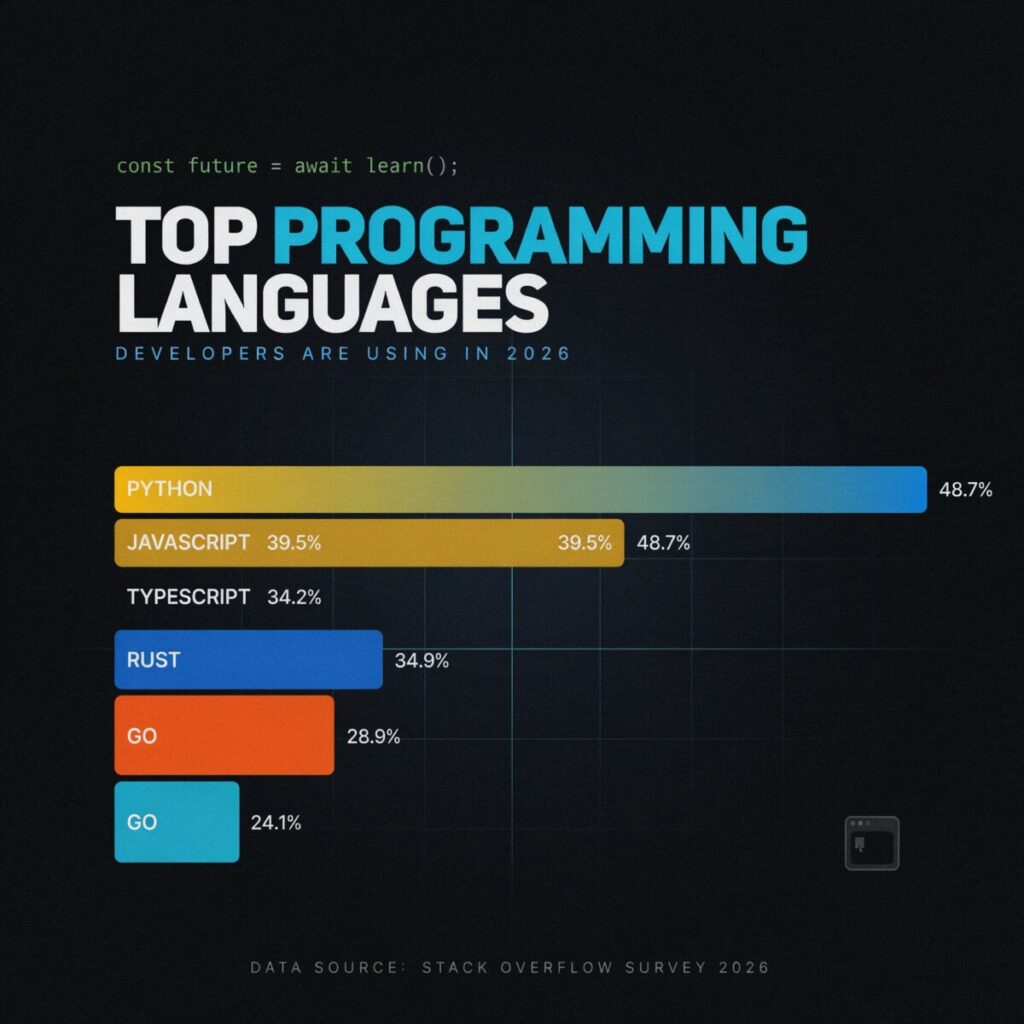
These macro shifts have reshuffled the leaderboard of the most popular programming languages. Python finally overtook JavaScript on GitHub (Octoverse 2024), Rust has consolidated its reputation as the most admired language for the ninth consecutive year, and TypeScript has moved from “nice-to-have” to de-facto standard for any serious web codebase. Meanwhile, newer entrants from systems programming (Zig, Odin) and AI-native frameworks (Mojo) are carving out dedicated niches.
For developers, the stakes are career-defining: the languages you invest in today determine the roles you are eligible for next year. For engineering leaders and product managers, they determine the size of your hiring pool, the velocity of your roadmap, and the total cost of maintaining a system for the next five to ten years. This article surveys the top programming languages for developers in 2026, grounded in usage data, hiring signals, and real ecosystem maturity — not hype.
Methodology and Data Sources
Ranking programming languages 2026 requires triangulation. No single index tells the full story, so we combine four signal categories:
- Usage and adoption — from the Stack Overflow Developer Survey 2024 (65,000+ respondents) and GitHub Octoverse reports, which track repositories, push activity, and contributor counts across 518+ million projects.
- Job-market demand — aggregated from LinkedIn, Levels.fyi, and regional job boards, cross-referenced with salary benchmarks for senior IC roles in the US, EU, and India.
- Community and ecosystem health — package registry activity (npm, PyPI, crates.io, Go modules), Stack Overflow question volume, and maintainers-per-project ratios.
- Forward-looking sentiment — “admired” and “wanted” scores, language-of-choice for new greenfield projects, and VC/startup tech-stack signals.
Where precise 2026 figures are unavailable, we rely on the most recent published data (typically late 2024 through early 2026 releases) and describe trends rather than inventing point estimates. Trend direction, not a single percentage, is what actually predicts where languages end up over a multi-year horizon.
| Language | Primary use cases | Hiring demand 2026 | Ecosystem maturity | Best for |
|---|---|---|---|---|
| Python | AI/ML, data, automation | ■■■■■ | High | AI product teams |
| TypeScript / JS | Web, serverless, full-stack | ■■■■■ | Very high | Web & full-stack |
| Rust | Systems, WebAssembly, infra | ■■■■ | Medium-high | Performance-critical infra |
| Go | Cloud-native, microservices | ■■■■■ | High | Backend platform teams |
| Java / Kotlin | Enterprise, Android, backend | ■■■■■ | Very high | Regulated industries |
| C# | Enterprise, Unity, cloud | ■■■■ | Very high | Game & enterprise |
| Swift | iOS / Apple ecosystem | ■■■ | High | Apple-first mobile |
| Dart (Flutter) | Cross-platform mobile/desktop | ■■■ | Medium-high | Multi-platform UI |
Language Profiles
1. Python — The Default for AI and Data
Python’s 2024 coronation as GitHub’s most-used language was not a fluke; it was the culmination of a decade of compounding advantage. Every major foundation model released between 2023 and 2026 — from Llama to Mistral to the Gemini family — has shipped a Python-first SDK. The Python data science libraries stack (NumPy, pandas, polars, scikit-learn, PyTorch, JAX) remains the shortest path from hypothesis to deployable model.
Key sectors: machine learning engineering, data engineering, quantitative finance, scientific computing, DevOps glue (Ansible, Fabric), and backend APIs (FastAPI, Django).
Ecosystem highlights: FastAPI now powers a meaningful slice of new production backends; Polars has displaced pandas for many large-scale ETL pipelines; Mojo (from Modular) targets Python-compatible AI kernels with near-C performance.
Performance vs. productivity: Python’s interpreter overhead is real, but 2026 workloads are rarely pure-Python hot loops. The typical pattern is a typed Python orchestration layer calling into Rust or CUDA kernels — which is exactly what Polars, Hugging Face’s tokenizers, and PyTorch itself do.
Hiring demand & salary: Consistently top-3 globally. Senior ML engineers in the US command $180k–$280k base plus equity; Python-literate platform engineers are nearly as scarce.
- ✅ Largest library ecosystem on the planet; beginner-friendly; dominant in languages for AI and machine learning.
- ❌ GIL still shapes concurrency stories (despite per-interpreter progress); mobile and browser targets are poor fits; raw throughput lags compiled languages by 10×–100× on tight loops.
2. TypeScript and JavaScript — The Undisputed Web Substrate
The TypeScript vs JavaScript 2026 debate has largely resolved in TypeScript’s favor for any codebase that expects to live more than a year. Stack Overflow 2024 reported TypeScript at 38.5% adoption among all developers and over 43% among professional respondents — and GitHub Octoverse confirms that most new JavaScript-ecosystem commits are actually TypeScript. JavaScript remains the most-pushed language and the only truly universal runtime (browser, Node, Deno, Bun, Cloudflare Workers).
Key sectors: frontend (React, Solid, Svelte), full-stack (Next.js, Remix), serverless (AWS Lambda, Deno Deploy), desktop (Electron, Tauri with a TS frontend), and increasingly edge middleware.
Notable frameworks: Next.js 15+, SvelteKit, Remix, NestJS for backends, tRPC for end-to-end type safety, and Deno as a credible Node alternative.
Performance notes: V8 and JavaScriptCore have matured into formidable JIT engines. For latency-sensitive edge code, the serverless programming languages shortlist almost always includes JS/TS thanks to millisecond-scale cold starts on platforms like Cloudflare Workers and Fastly Compute.
Hiring demand: The deepest talent pool on Earth. Mid-level salary bands in the US sit around $140k–$200k.
- ✅ Universal runtime; enormous community; unmatched best language for web development 2026 claim.
- ❌ Tooling churn is exhausting (bundler-of-the-month fatigue); type system is sound-ish, not sound; Node’s ecosystem has had notable supply-chain incidents.
3. Rust — Safety, Speed, and the Quiet Systems Takeover
Rust’s admiration score (83% in Stack Overflow 2024, the highest for any language for the ninth year running) understates its real-world footprint in 2026. It now ships inside the Linux kernel, underpins the core of Android’s Bluetooth stack, powers Cloudflare’s edge proxy (Pingora), is the implementation language of Deno and Turbopack, and is the primary source language for WebAssembly modules that target the browser, WASI runtimes, and embedded microcontrollers.
Key sectors: systems programming, WebAssembly languages toolchains, database engines (Neon, SurrealDB), CLI tooling (ripgrep, bat, zoxide), performance-critical microservices, and crypto infrastructure.
Rust performance and safety claims are not marketing: memory safety without a garbage collector, deterministic resource cleanup via RAII, and a type system expressive enough to catch data races at compile time. Benchmarks consistently place idiomatic Rust within single-digit percent of hand-tuned C++ on throughput-bound workloads.
Ecosystem: tokio for async, axum for HTTP, sqlx for typed SQL, serde as perhaps the best serialization library in any language, and cargo as the gold-standard package manager.
Hiring demand: Growing fastest among systems languages. Senior Rust roles in the US often pay $200k–$320k, reflecting scarcity.
- ✅ Memory safety without GC; fearless concurrency; superb tooling; a natural fit for languages for systems programming.
- ❌ Steep learning curve (the borrow compiler will reject your first week’s code); compile times on large workspaces remain a pain point; smaller hiring pool than Go or Java.
4. Go — The Language of Cloud-Native
If Kubernetes, Docker, Terraform, Prometheus, and Caddy share a trait beyond being open source, it is that they are written in Go. In 2026, Go is practically the official language of the platform layer. Go microservices are the default shape for greenfield backend services at startups and scale-ups alike, and the language’s single-binary deployment model is a first-class advantage in containerized environments.
Key sectors: platform engineering, SRE/DevOps tooling, API gateways, observability agents, gRPC services, and increasingly cloud-native languages workloads on Kubernetes.
Ecosystem highlights: standard library HTTP server (augmented by Chi or Fiber), pgx for Postgres, ent and sqlc for data access, and cobra for CLI scaffolding. Go 1.21+’s generics and structured logging reduced much of the historical boilerplate complaint.
Performance vs. productivity: Go deliberately trades raw throughput for a fast, predictable compile, tiny binaries, and a concurrency model (goroutines + channels) that lets a junior engineer write highly concurrent services. A typical Go service handles 10,000+ requests/second on modest hardware with sub-100ms p99 latency.
Hiring demand: Extremely strong for backend/platform roles; US senior compensation $160k–$240k.
- ✅ Fast compile, simple syntax, outstanding concurrency, excellent standard library.
- ❌ Verbose error handling (the
if err != nilmeme persists); generics are still less expressive than Rust or Haskell; dependency story (go mod) can surprise newcomers.
5. Java and Kotlin — The Enterprise Backbone
Java remains a top-5 language by every measure (GitHub 4th in 2024, Stack Overflow ~30%), and its position in regulated industries — banking, insurance, government — is essentially unassailable. What has genuinely changed since 2022 is the adoption curve of Kotlin Android development and Kotlin Multiplatform. Google’s Kotlin-first posture has made Kotlin the default for any new Android module, and Spring Boot 3+ pairs cleanly with Kotlin coroutines for backend services.
Key sectors: enterprise backends (Spring Boot, Quarkus), Android apps, big-data tooling (Kafka, Flink, Spark), and — increasingly — multiplatform libraries shared between Android, iOS, and JVM servers.
Ecosystem: Spring Boot 3.x with GraalVM native image for sub-second cold starts; Micronaut and Quarkus as lighter-weight alternatives; Kotlin Coroutines for structured concurrency; JetBrains Compose Multiplatform bridging UI across targets.
Hiring demand: The largest enterprise hiring pool on the planet. Salaries for senior Java engineers remain steady ($150k–$220k US), while Kotlin Android development specialists command a modest premium where the talent pool is thinner.
- ✅ Massive ecosystem, JVM portability, unmatched library depth, proven at scale for decades.
- ❌ Java’s verbosity still taxes teams that haven’t adopted records, sealed classes, and pattern matching; Kotlin compilation and multiplatform builds can be slow and fiddly.
6. C# — Quiet Resurgence, Thanks to Unity and .NET 8+
C#’s 2026 position is stronger than most public commentary suggests. .NET 8 and 9 delivered significant throughput improvements (ASP.NET Core regularly tops the TechEmpower benchmarks), AOT compilation has made .NET viable for AWS Lambda and containerized microservices, and Unity continues to anchor C# as a top choice for indie and mid-tier cross-platform mobile frameworks-adjacent game development.
Key sectors: enterprise backends (especially in Microsoft-centric shops), game development via Unity, desktop apps with MAUI/WinUI, and Blazor for in-browser .NET.
Hiring demand: Stable to growing; compensation on par with Java senior roles.
- ✅ Modern language features (records, pattern matching, async/await pioneer); first-class IDE tooling in Rider and Visual Studio.
- ❌ Perception of being Microsoft-centric persists; smaller open-source mindshare outside game and enterprise circles.
7. Swift — The Apple-Ecosystem Default
For anyone shipping to iOS, macOS, watchOS, or visionOS in 2026, Swift iOS development 2026 is simply the answer. SwiftUI has matured enough that most new Apple-platform projects default to it; server-side Swift (via Vapor and Hummingbird) has a credible niche; and Swift 6’s strict concurrency checking materially reduces data-race bugs.
Key sectors: native Apple apps, AR/visionOS experiences, and a small-but-steady server-side community.
Hiring demand: Niche but well-compensated; US senior iOS engineers are consistently $160k–$250k.
- ✅ Best-in-class tooling via Xcode; strong safety features; Swift Concurrency (async/await, actors) is ergonomic.
- ❌ Tightly coupled to Apple’s platform cadence; smaller ecosystem outside Apple targets; ABI stability still leaves edge cases.
8. Dart and Flutter — Cross-Platform UI at Scale
Dart’s story in 2026 is overwhelmingly a Flutter story, but it is a very good one. Flutter 3.x ships to iOS, Android, web, Windows, macOS, and Linux from one codebase, and its Impeller rendering engine has closed most of the historical jank complaints. Dart itself is pragmatic, typed, productivity-focused, and increasingly adopted for standalone server work by teams that also use Flutter.
Key sectors: cross-platform consumer apps, embedded UI in automotive and kiosk hardware, and internal tools at companies already on the Flutter stack.
Hiring demand: Growing in emerging markets and agencies; US salaries slightly below native iOS/Android but competitive for generalist mobile roles.
- ✅ Single codebase across six platforms; hot reload; strong widget ecosystem.
- ❌ App size and native-bridge overhead; smaller talent pool than React Native’s JavaScript base.
R retains a devoted base in biostatistics, econometrics, and the tidyverse ecosystem. Julia continues to win converts in scientific computing for its 1x-of-C performance with Python-like syntax, and the 2025 release of SciML and DifferentiableProgramming toolkits strengthened its ML-adjacent position. Neither is on the generalist hiring chart, but both are the answer in their niches.
Emerging and Niche Languages to Watch
Three trends define the programming language trends 2026 frontier:
- Zig — a modern C-replacement with manual memory management, no hidden control flow, and the ability to compile C/C++ code out of the box. Bun (the JavaScript runtime) is written in it; TigerBeetle (a financial database) uses it. It is on the cusp of leaving “promising” territory.
- Mojo — Python-superset designed for AI hardware. If Modular’s claims hold across 2026 production workloads, Mojo could carve out a durable corner of ML infra.
- Domain-specific languages — SQL’s renaissance (DuckDB, data-stack-as-code), Rego (Open Policy Agent), and CUE (configuration) reflect a broader truth: the future is polyglot, and DSLs often outperform general-purpose languages in their lanes.
Low-code / no-code platforms (Retool, Appsmith, internal AI builders) are not replacing developers; they are shifting the boundary of what gets coded by hand versus composed visually. The languages above are where the custom layer still needs to live.
Choosing the Right Language: A Practical Framework
There is no single winner — only the right trade-off for your context. Weigh five factors:
- Problem fit. AI/ML → Python. Backend at scale → Go or Java/Kotlin. Web product → TypeScript. Systems / infra → Rust. Apple app → Swift.
- Hiring pool. A perfect language with no senior engineers available is worse than an “okay” language with deep bench strength.
- Long-term maintenance. Languages with stable backward-compatibility guarantees (Java, Go, C#) cost less to sustain over a decade than fast-moving ones.
- Ecosystem maturity. For production services, prefer ecosystems with battle-tested libraries for your exact stack (auth, observability, database drivers).
- Developer attraction. Performance vs productivity languages is partly a who-wants-to-work-here question. Rust and Go, in particular, signal a certain engineering culture.
For teams, a sensible default in 2026 is TypeScript on the frontend, Go or Kotlin on the backend, Python for data/ML workloads, and Rust only where the performance or safety payoff justifies the learning investment.
Learning Resources and Next Steps
- Official docs:
docs.python.org,typescriptlang.org,doc.rust-lang.org/book,go.dev/learn,kotlinlang.org/docs,developer.apple.com/swift,dart.dev,learn.microsoft.com/dotnet/csharp. - Interactive: Exercism (free mentored tracks for every language above), Advent of Code for fluency under pressure.
- Courses: Rust for Rustaceans (No Starch), Programming Kotlin (PragProg), Fast.ai for applied ML in Python, Frontend Masters for TypeScript depth.
- Community: local meetups, language Discords/Zulips, and the /r/ subreddits remain the fastest way to find mentors and co-contributors.
- Certifications: less important than a public GitHub portfolio — two well-documented side projects outrank most paid certs on a resume.
Conclusion
The top programming languages for developers in 2026 reflect a world where AI, cloud-native, and multi-platform delivery are baseline expectations rather than differentiators. Python owns the AI stack; TypeScript owns the web; Rust is the language of the systems layer renaissance; Go powers platform engineering; Java/Kotlin anchor the enterprise; C# quietly ships games and backends; Swift owns Apple; Dart and Flutter collapse the mobile surface area.
There is no universal best language. There is only the best language for the next system you are building or the next role you want. Pick one deliberately, ship something real with it this month — a small API, a CLI tool, a weekend automation — and let the work, not the hype cycle, decide what goes deeper on your roadmap.
Your next move: pick one language from this list that you don’t currently use day-to-day. Spin up a 2-hour project this weekend (a FastAPI endpoint, a tiny Rust CLI, a Go microservice) and commit it to a public repo. Bookmark this article for your next hiring or architecture review — and share it with a teammate who’s about to choose a stack for Q3.