
In just a few years, artificial intelligence has moved from research labs into the fabric of everyday life. It drafts emails, flags fraudulent card charges, suggests your next song, helps radiologists read scans, and tutors students in math. In fact, McKinsey’s 2025 global survey found that 88% of organizations now use AI in at least one business function . Meanwhile, Gallup reports that about two-thirds of remote-capable U.S. workers have used AI at work .
This rapid growth raises a pressing question: is AI competing with human intelligence, or becoming a tool that expands human capability? The honest answer is both—and understanding the difference between AI and human intelligence is the key to navigating what comes next.
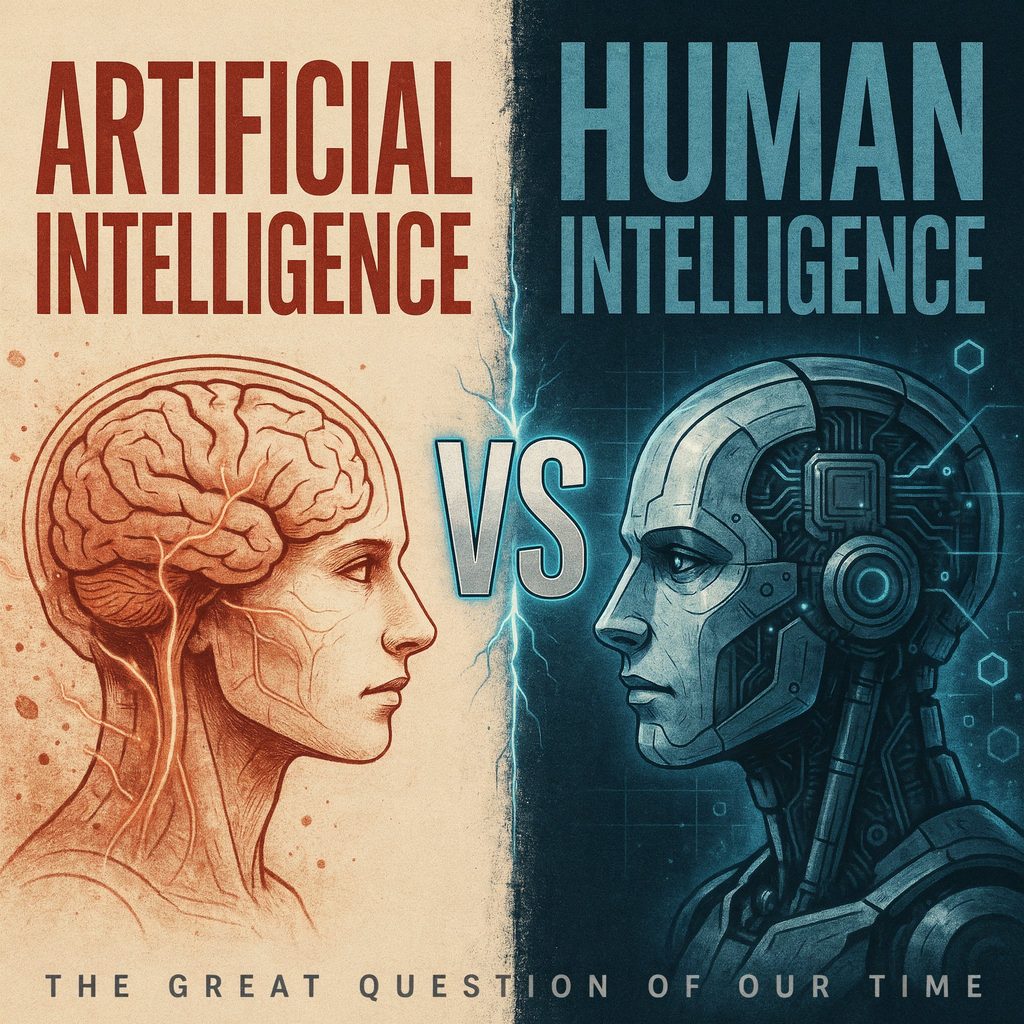
In plain terms, artificial intelligence refers to computer systems designed to perform tasks that normally require human intelligence, such as recognizing patterns, understanding language, and making predictions. Human intelligence, by contrast, is the broad, flexible capacity to learn, feel, judge, create, and care—shaped by emotion, culture, and lived experience.
In this guide to artificial intelligence vs human intelligence, we’ll compare AI capabilities with human cognitive abilities, examine where each excels, and explore job impact, ethics, creativity, and the future of human-AI collaboration.
What Is Artificial Intelligence?
Artificial intelligence (AI) is an umbrella term for machines that simulate aspects of human thinking. Instead of following only fixed rules, modern AI systems learn from examples. Here are the building blocks, in plain language:
- Machine learning: Computers learn patterns from data instead of being explicitly programmed for every scenario.
- Deep learning: A more powerful form of machine learning that uses layered networks loosely inspired by the brain, behind breakthroughs in image and speech recognition.
- Generative AI: Systems that produce new content—text, images, music, code, and video—rather than only analyzing data.
- Large language models (LLMs): The technology behind modern chatbots, trained on vast amounts of text to predict and generate human-like language.
- Natural language processing (NLP): Helping computers understand and produce human language, from translation apps to voice assistants.
- Computer vision: Teaching machines to interpret images, from face unlock on your phone to analyzing X-rays.
- Automation and predictive analytics: Using AI automation to run repetitive workflows and forecast what’s likely to happen next.
AI You Already Use
You encounter these technologies constantly: AI chatbots answering support questions, recommendation engines on streaming and shopping sites, voice assistants, fraud detection systems protecting bank accounts, image-generation tools, self-driving technology in newer cars, and medical diagnostic support systems that help clinicians spot early signs of disease.
One important nuance: today’s AI is “narrow.” It is highly capable within trained tasks but lacks consciousness, self-awareness, and the general common sense of the human brain. A machine that could match human ability across any intellectual task is called artificial general intelligence (AGI)—still a research question, not a reality.
What Is Human Intelligence?
Human intelligence is far more than an IQ score or fast information processing. It is the integrated ability to learn from experience, reason under uncertainty, feel emotions, and act with purpose.
Distinctly human strengths include:
- Emotional intelligence and empathy – sensing how others feel and responding with care.
- Ethical judgment and moral reasoning – weighing what is right, not just what is efficient.
- Common sense and critical thinking – questioning assumptions and spotting what doesn’t add up.
- Adaptability and contextual understanding – adjusting to new, ambiguous, unfamiliar situations.
- Social awareness – reading a room, building trust, navigating culture.
- Intuition – a felt sense that something is off, even before you can prove it.
- Creativity shaped by lived experience – making work that carries personal meaning.
Human intelligence is also embodied and social. It is influenced by culture, emotion, memory, relationships, physical experience, and personal values. The human brain learns from remarkably few examples, transfers knowledge across domains, and genuinely cares about outcomes. That is why, in any comparison of AI vs human brain, the brain remains astonishingly efficient, flexible, and purpose-driven—qualities machines have not replicated.
Artificial Intelligence vs Human Intelligence: Key Differences
The difference between AI and human intelligence becomes clearer side by side:
| Factor | Artificial Intelligence | Human Intelligence |
|---|---|---|
| Learning process | Learns from training data and patterns | Learns from experience, observation, emotion, and context |
| Speed | Processes large data sets rapidly | Slower at repetitive calculations but strong in judgment |
| Memory | Can store and retrieve massive information | Selective, experience-based, and sometimes imperfect |
| Creativity | Generates outputs from learned patterns | Creates with purpose, emotion, culture, and lived experience |
| Emotions | Simulates emotional language but does not feel | Experiences real emotions and empathy |
| Decision-making | Data-driven and rule-based | Values-driven, contextual, and ethical |
| Adaptability | Limited by training, tools, and system design | Can adapt to unfamiliar and ambiguous situations |
| Accountability | Cannot hold moral or legal responsibility | Can be accountable for choices and consequences |
What These Differences Look Like in Real Life
- Customer service: A chatbot resolves thousands of routine questions instantly, but a human agent hears frustration in a customer’s voice and knows when to bend a policy to preserve the relationship.
- Medical diagnosis: AI flags patterns in scans at impressive speed, while a doctor integrates history, symptoms, and a patient’s values before deciding what to do next.
- Education: Adaptive software personalizes practice problems, but a teacher notices when a student is hungry, anxious, or quietly losing confidence—and responds.
- Content creation: Generative AI drafts a blog post in seconds, yet human editors add strategy, taste, and authenticity that audiences can feel.
- Business strategy: AI forecasts demand and simulates scenarios, but leaders make the final call under uncertainty, balancing data with ethics, culture, and long-term trust.
In short: AI optimizes. Humans decide what is worth optimizing.
Where AI Performs Better Than Humans
There are domains where artificial intelligence clearly outperforms us, especially when tasks involve scale, speed, and repetition:
- Analyzing vast data volumes no human team could read in a lifetime.
- Recognizing subtle patterns, from unusual transactions to early signs of equipment failure.
- Handling repetitive tasks without boredom, fatigue, or loss of focus.
- Operating continuously, answering customers and monitoring systems around the clock.
- Producing fast predictions and recommendations, such as next-best-offer suggestions in AI in marketing.
- Detecting anomalies in AI in cybersecurity and finance, flagging fraud in milliseconds.
- Supporting scientific research and drug discovery, such as predicting protein structures to accelerate lab work.
- Automating routine workflows, from invoice processing to scheduling.
Consider AI-assisted financial fraud detection: models review millions of transactions in real time, catching patterns humans would miss. Supply-chain forecasting helps retailers stock the right products before demand spikes. Marketing automation personalizes messages at a scale no human team could match, and customer support chatbots resolve simple issues instantly, freeing people for complex cases.
But here is the essential reminder: fast or accurate-looking output is not the same as a correct, fair, or responsible decision. AI can be confidently wrong. That is why human oversight in AI systems is not a formality—it is a necessity.
Where Human Intelligence Still Leads
For all its power, AI has clear limitations. Humans remain essential wherever work involves:
- Empathy and compassion
- Leadership and relationship-building
- Ethical decision-making
- Negotiation and conflict resolution
- Cultural sensitivity
- Accountability
- High-stakes judgment
- Original vision and purpose
- Complex problem-solving under uncertainty
Picture real-world moments no algorithm can truly handle. A doctor communicating a difficult diagnosis must read fear in the room, explain options with honesty and hope, and respect a patient’s values. A teacher motivating a struggling student draws on trust and belief, not just content knowledge. A manager handling team conflict reads history, emotion, and unspoken dynamics. A business leader reviewing an automated loan denial must ask whether the decision is not only legal but fair.
These are not soft extras to the “real work.” They are the real work. Human empathy, human judgment, and accountability are exactly what we demand in medicine, justice, education, and leadership—and exactly what software cannot provide.
Can AI Be Truly Creative?
This is one of the liveliest debates in AI creativity. Generative AI can compose music, paint images, write poetry, and generate video by identifying statistical patterns in enormous datasets. The results can be impressive—and useful.
Yet there is a meaningful difference between generating content and creating with intent. Human creativity grows from lived experience: joy, grief, culture, memory, and purpose. When an artist makes something, they mean something by it. An AI model has no life to draw on, no emotions to express, and no self-awareness about why its output might matter.
A balanced view is more useful than either hype or dismissal:
- AI accelerates brainstorming and production, generating ideas, variations, and first drafts at speed.
- Human creators provide strategy, authenticity, taste, storytelling, and ethical direction.
- The strongest creative workflows combine AI efficiency with human editing and original insight.
Serious concerns accompany these tools. AI copyright concerns focus on the training data used to build models. AI misinformation and AI deepfakes make it easier to spread convincing falsehoods, and plagiarism challenges educators and publishers. The sensible response is transparency: disclose when generative AI content is used, verify before sharing, and keep a human accountable for what gets published. If you’re exploring these tools practically, our guides on [how generative AI works] and [AI tools for small businesses] are good next steps.
Will AI Replace Human Jobs?
Headlines often ask whether AI is replacing jobs, but the reality is more nuanced: automation usually targets tasks, not entire occupations. That is the heart of the automation versus augmentation debate.
Roles with the highest exposure tend to involve repetitive or predictable tasks—data entry, routine scheduling, basic report writing, standardized customer queries. Yet even here, AI is more likely to change jobs than erase them. In customer service, agents handle complex cases while bots take the routine. In software development, engineers review and architect while AI suggests code. Across accounting, marketing, design, manufacturing, healthcare, and education, AI in business is shifting emphasis toward judgment, strategy, and relationships.
History suggests technology changes the composition of work more than it eliminates the need for workers. The future of work with AI will reward people who combine domain expertise with AI skills for the future: AI literacy, data skills, critical thinking, communication, and the ability to learn quickly. Reskilling and upskilling are not buzzwords; they are the practical bridge to the next decade. AI job displacement is real for certain tasks and deserves honest planning and policy—but the larger story is augmentation: people using intelligent tools to do more valuable work.
How Professionals Can Prepare
- Learn to use AI tools responsibly, knowing their strengths and failure modes.
- Strengthen communication and critical thinking, the skills that make output useful.
- Build deep industry expertise that gives context AI lacks.
- Focus on work that requires trust and relationships.
- Verify AI-generated information before acting on it.
- Understand data privacy and cybersecurity basics.
- Treat AI as a productivity assistant, not an unquestioned authority.
The Ethics of AI vs Human Decision-Making
As AI decision-making enters high-stakes areas of life, AI ethics has moved from philosophy seminars to boardrooms and legislatures. Key concerns include:
- AI bias: Models trained on historical data can inherit and amplify human prejudices.
- Data privacy and AI: Systems consume vast personal information, raising consent and security questions.
- Surveillance: Powerful tools can be misused to monitor and profile people.
- Transparency and explainability: People deserve to know when—and how—algorithms affect them.
- Copyright and intellectual property: Who owns what a model generates, and what was used to train it?
- AI hallucinations: Systems sometimes state fabricated information with complete confidence.
- AI misinformation and deepfakes: Synthetic media can deceive at scale.
- Security risks: AI systems can be attacked, manipulated, or stolen.
- AI accountability: When an automated decision harms someone, who is responsible?
This is why ethical AI and responsible AI practices matter. Human oversight, clear AI governance, independent testing, regular audits, and thoughtful AI regulation are essential—especially in hiring, lending, healthcare, criminal justice, education, and public services. A model can recommend; only a person can be accountable. That principle should anchor every deployment of AI. For a deeper dive, see our article on the [ethical use of artificial intelligence].
What’s Next for AI and Human Intelligence?
The future of artificial intelligence will likely be defined less by machines versus humans and more by partnership between human intelligence and AI. Expect to see:
- Human-AI collaboration becoming the default in knowledge work.
- AI copilots supporting decisions in business and education.
- Personalized learning systems adapting to each student’s pace in AI in education.
- AI-powered healthcare support, from earlier detection to administrative relief for clinicians in AI in healthcare.
- Smarter accessibility tools for people with disabilities.
- Robotics and AI automation advancing in warehouses, factories, and homes.
- Multimodal AI systems working fluently across text, images, voice, and video.
- Increased regulation and AI governance as societies set guardrails.
- Greater demand for responsible AI use in every industry.
The most important insight is this: the future is not simply “AI versus humans.” It will be shaped by the choices people, organizations, and governments make about how AI is designed, deployed, regulated, and supervised. Technology sets the options; human values set the direction.
Conclusion
When we compare artificial intelligence vs human intelligence honestly, the picture is not a rivalry—it is a division of labor. AI is unmatched at speed, scale, pattern recognition, and automation. Humans remain uniquely valuable for empathy, values, accountability, context, and purposeful creativity.
The smartest path forward is neither fear nor blind optimism. It is intentional collaboration: using AI productivity tools to expand what we can do, while keeping human judgment at the center of decisions that affect people’s lives. Whether you’re a student, a professional, or a business owner, the opportunity is the same—learn the tools, keep your judgment sharp, and stay human at the center.
The future belongs not to AI alone or humans alone, but to people who learn how to use intelligent tools wisely, ethically, and creatively.
FAQ
1. What is the main difference between artificial intelligence and human intelligence?
AI is engineered pattern recognition: it learns from data and excels at speed and scale. Human intelligence is broad and flexible, combining reasoning with emotion, ethics, common sense, and lived experience. AI simulates aspects of thinking; humans actually live it.
2. Can AI think like a human?
Not today. Current systems, including large language models, process statistical patterns in data. They can produce human-like language without understanding, beliefs, or consciousness. The AI vs human brain comparison remains a difference in architecture—and in experience.
3. Will AI replace humans in the workplace?
AI will automate many tasks, especially repetitive and predictable ones, but full job replacement is the exception, not the rule. Most roles will transform: humans focus on judgment, creativity, relationships, and oversight while AI handles routine work.
4. Is AI more intelligent than humans?
In narrow tasks, often yes—AI can outperform people at specific calculations, pattern recognition, and data analysis. In general intelligence, no. Humans outperform AI in adaptability, common sense, emotional understanding, and ethical reasoning.
5. Can artificial intelligence have emotions?
No. AI can recognize emotional cues and simulate empathetic language, but it does not feel anything. Emotions arise from biology, embodiment, and personal experience—none of which software possesses.
6. How can people prepare for an AI-driven future?
Build AI literacy: learn to use AI tools critically and responsibly. Invest in reskilling and upskilling, deepen your domain expertise, sharpen communication and critical thinking, and focus on work that requires trust, empathy, and accountability.